Organizational Energy is Data
This week, my 12-year-old son and I took an Aikido class for the first time. I find that at his age especially, learning something new together (both of us complete beginners) is a deeply connecting experience. But that's an article for another time. ;)
From my very novice understanding, Aikido is largely about building a relationship to, and awareness of, energy, with the goal of moving through conflict in less harmful ways. Energy becomes a source of data, something to read and move with rather than fight against.
Energy as a resource
In my work, I've been thinking a lot about organizational energy as a source of data and insight. Not in a fluffy, esoteric way, but in a very practical one. Specifically, how to help my clients:
Protect energy as a vital resource
Notice patterns in how it shifts
Anticipate and respond to those shifts in ways that make the most of particular windows of time: moments when an organization's energy is especially well suited to a given intervention or transformation
Many great leaders and teams already do this instinctively like not scheduling a wave of trainings during performance review season, when energy is already scarce. Or devoting L&D resources to help teams get better at collaborating. Or sending all-company communications out at a time of the week when people are more open and receptive, or at least less flooded and overwhelmed. Of course, not every intervention can wait for the ideal moment, and organizational energy is nuanced, varying by individual, group, geography, even team sub-culture.
Reading the signals
Energy is harder to measure than other metrics, like revenue or attrition. But it still leaves leading and lagging indicators, if you know where to look.
Signs of an energetic dip: dropping engagement, slipping timelines, rising escalations, decisions that don't get made, conflict that stays stuck, people telling you they're overwhelmed.
Signs of a positive shift: more engagement in org initiatives, new ideas surfacing, silos dissolving, a stronger sense of alignment, more willingness to help across teams, decisions made efficiently and closer to the people doing the work, teams investing deliberately in their own learning.
Noticing the seasons
For better or worse, a lot of organizational energy is driven by fairly arbitrary milestones. The systems we operate in, especially in the Western world, nudge along collective feelings of anticipation, momentum, haste. At other points in the year, those same patterns spark a willingness to slow down, reflect, connect, or actively grow.
Think of the hustle-then-release at the end of a calendar year, as much of the world sets up for holidays and time off. Or the start of any "new year" (fiscal, Gregorian, Lunar), which tends to bring a mix of reflection, honoring what's passed, and fresh aspiration.
Most organizations I've worked with over the last couple of decades have also noticed a distinct pattern around September and October. In much of the world (not all), this aligns with the return to school. Whether it's preschool or university, this stretch marks the end of summer. It’s a season that usually brings a more buoyant energy after some time away from work, and time with the people we love. Then, as the "rentrée" begins (as the French call it), there's a shift toward deliberate learning and growth. I've watched this "back-to-school energy" become genuinely palpable inside organizations, as adults pick up, by a kind of osmosis, on the studious mood of the kids around them.
None of this is a new observation. But it's worth naming as a clear example of recognizing when a team's energy opens a window for learning or transformation.
Try this: map your own team's energy
A disclaimer: this is my own ‘back of a napkin’ model, inspired by other explorations of energy and engagement. Like the physics and physiology of energy, and how energy and tension shape kids' ability to self-regulate. It's undoubtedly flawed and oversimplified.
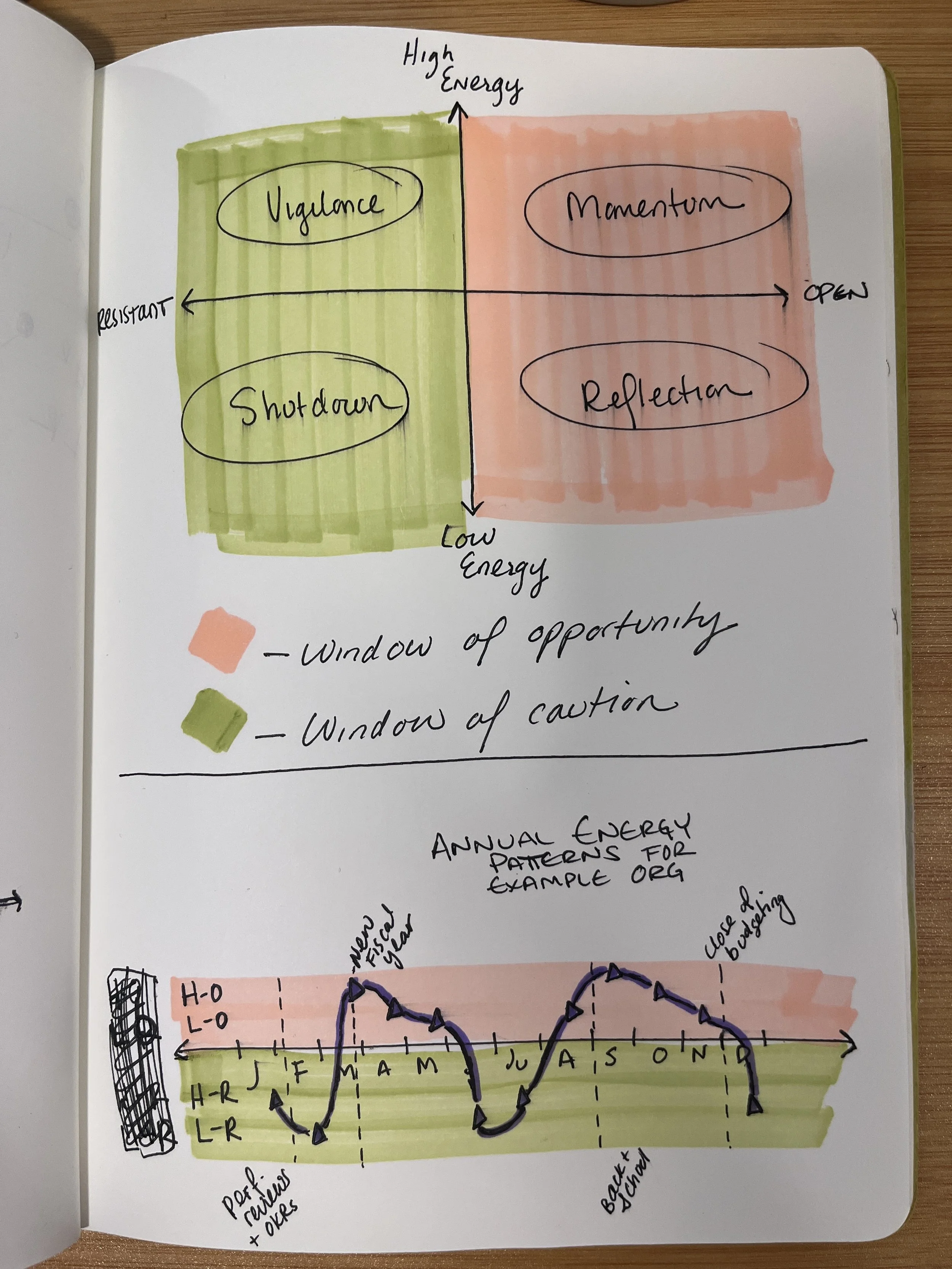
Sketch of Organizational Energy Map and Matrix
Step 1
Pick a period of the year and ask how much energy, openness, or resistance your org, your team, or you personally tend to have at that moment. Alternatively, consider how that energy trends over the course of a year.
Step 2
Plot where your team or org energy generally sits during that period:
High-open energy: a great time for launching bigger culture change, learning, or transformation initiatives
Low-open energy: a great time to integrate, distill, or embed initiatives you've already launched
High-resistant energy: an anxious, reactive, vigilant time, best suited to no-pressure listening sessions and facilitated dialogue
Low-resistant energy: the highest-risk zone. Trust and energy need to be rebuilt in small, low-stakes moments (1:1s or small-group listening) rather than in big, wide-audience sessions
This is an exercise in anticipation and imagination, not science. We're looking for averages and trends, not certainties, since many things can shift a given org's, team's, or individual's energy year to year.
A note on resistance: resistance is not bad. It's a requirement for understanding the true state of an org, and for knowing how to respond. The goal isn't to eliminate it — like building strength in the body, resistance is what increases our capacity to carry energy over time. As Nirosha J. Murugan and Martin Picard put it, describing resistance in biological systems: "It's like how the circuitous path of a riverbed reflects the course of water over time. The flow of energy is the water rushing down the river, eroding and shaping the river's bed, its contours, and its depth."
“[Energy and resistance] It’s like how the circuitous path of a riverbed reflects the course of water over time. The flow of energy is the water rushing down the river, eroding and shaping the river’s bed, its contours, and its depth.”
A few examples
Several organizations I’ve worked are great examples of responding to shifts and patterns to organizational energy.
The deliberate pause. One global organization (a team of about 130) had been sitting in Low-Resistant energy for too long. Staff had lost trust in leadership, and a large share of the team was on the verge of burnout. The exec team made a brave call: a two month-long pause. Explicitly no progress, no delivery. Nearly all project meetings and checkpoints were cancelled; the instruction was clear: do not move work forward, restore and resource instead. It was harder than they expected, but it paid off. The pause let people genuinely recover, and on the other side of it, two things became clear: what to prioritize, and what wasn't worth picking back up because the energy drain outweighed the impact. Just as important, the team dug into, and committed to changing the cultural patterns that had put them in that state in the first place.
Timing a leadership program to the calendar. With another organization, 1800 employees across four continents, we designed a senior leadership development program and deliberately placed it inside the most open-energy windows of the year. We launched in person with 90 VPs from around the globe at the start of the fiscal year, after year-end reporting had closed and strategic priorities had been set, when the group had both momentum and some mental spaciousness. The goal was to dissolve silos that had been blocking cross-collaboration, so timing that first deep-learning moment to when the org's energy was actually open mattered. The rest of the program embedded new collaboration skills through peer learning over the following months, largely in the flow of everyday work and light virtual touch points. After summer, we planned to reconvene the group in a virtual summit (timed to the high-open "back-to-school" season) to re-engage their attention before business-as-usual inertia pulled everyone back in.
Why this matters
If you or your team influence an entire organization (senior leadership and exec teams, People, Learning, or Culture teams, I'm looking at you, aligning your most critical interventions with the org's actual energy and openness (whenever that's possible, which admittedly isn't always) gives you better odds of having the impact you're going for.
A lot of this happens naturally. But I'd argue some windows of time can be better designed for, and some interventions better placed, to reach people when they're genuinely open and willing to engage.
“If you or your team influence an entire organization, aligning your most critical interventions with the org’s actual energy and openness gives you better odds of having the impact you’re going for.”
Back to reality
Coming up is a key window: back-to-school season. Plenty of organizations are already planning strategic touch points for connection and learning.
I'm curious — how are you planning to support your org or team's growth this back-to-school season? And what skills or shifts matter most to you, your teams, or your clients as you head into the second half of the year?
How are you planning to support your org or team's growth this back-to-school season?
If you don't quite know yet, and want help seizing the moment before it passes, get in touch.
Until then, be well.
<3 Heidi Higginbottom